Let’s explore the amazing Dee Wright Observatory, an iconic landmark in central Oregon!
Without a doubt, this rocky observatory is one of the most unique road-side attractions in the state.
Constructed of the same lava rock as it was built on, the Dee Write Observatory offers 360 degree views of the surrounding landscape, including some of the most iconic mountain peaks in central Oregon.
In this article, we’ll cover everything you should know before visiting Dee Wright Observatory, including how to get there, when to go, and what to expect!
Dee Wright Observatory Overview
Situated at about 5,000 feet of elevation, the Dee Wright Observatory sits proudly atop at the highest point along the McKenzie Highway 242 at the border of the Willamette and Deschutes National Forests.

Surrounded by miles of black lava rock, the observatory is an ideal viewpoint for experiencing this bizarre and unique landscape.
In fact, the region is so otherworldly that NASA astronauts performed training there in 1964 to prepare for travels to the moon.

About 30 years earlier, the observatory was constructed in 1935 by the Civilian Conservation Corps.
We’ll dive into the geology and history later, but for now let’s cover the important stuff, including how to get there and when you can visit.
How to Get to Dee Wright Observatory
The observatory is located alongside the highest point of Highway 242, which is also called the McKenzie Highway or the “Old” McKenzie Highway.
| Starting Point | Typical Travel Time | Distance |
| Bend | 1 hr | 40 miles |
| Sisters | 25 min | 15 miles |
| Portland | 3 hr | 160 miles |
| Eugene | 1 hr 45 min | 80 miles |
| Salem | 2 hr 20 min | 120 miles |
There are paved parking spots, restroom facilities, and garbage services. No reservations, permits, or fees are required.
Be aware of the narrow and winding road and keep a close eye out for bikers!
When to Visit Dee Wright Observatory
Late spring through fall is generally the best time to visit the observatory.
In fact, the McKenzie River Highway is closed seasonally from November to mid-June, depending on the year. Check ODOT’s TripCheck before you go.

When the road is open, be aware of the harsh climate of this rugged and exposed lava field.
On hot days, aim to visit during mornings. The black rocks absorb heat and can increase temperatures to an uncomfortably toasty level, especially during the summer.

At the same time, cold and windy weather is common, particularly in late spring and fall, though even summer mornings and evenings can be brisk.
The Structure
The Dee Wright Observatory is constructed of the same lava rock that surrounds it, a strategic decision designed to blend the structure into the environment.

There is a single circular “room” in the observatory accessible from the parking area via a paved path. The room has a ceiling and walls but is otherwise open to the elements.

On all sides of this chamber are intentional viewing windows placed precisely for viewing specific mountain peaks. On the bottom of the windows are plaques with faded names of the peaks.

It is super fun to hop from window to window and observe each mountain peak individually! Climb the rounding stairs to the roof of the observatory for 360-degree views of the lava field and surrounding peaks.
There is a large metal circle at the top that draws lines towards each individual peak to help you get your bearings.

Mount Jefferson, Middle Sister, North Sister, Black Butte, Belknap Crater, Mount Washington and more peaks can be seen easily from the observatory during clear weather.

On an exceptionally clear day you can even see Mount Hood almost 80 miles north!
Geology and History
The surreal landscape surrounding Dee Wright Observatory is the result of intense volcanic activity that shaped central Oregon thousands of years ago.

The observatory sits atop a vast field of basaltic andesite lava rock formed by eruptions from nearby Yapoah Cone and Little Belknap Crater, which spilled molten basalt across the region roughly 2,600 to 2,900 years ago.
This dramatic terrain is part of the larger Cascade Volcanic Arc, a geologically active zone that stretches from British Columbia to Northern California.

After the lava cooled and before the observatory, the location intersected what was first a trail, then a wagon road, and finally a state highway in 1917.
The observatory itself is a relic of New Deal-era craftsmanship. Built in 1935 by the Civilian Conservation Corps, it was constructed entirely from native lava rock and designed to blend seamlessly into its surroundings.

The creators must have wanted to showcase prominent Cascade peaks, including Mount Washington, North Sister, and Mount Jefferson, because individual viewing windows were constructed that align perfectly with each mountain.
In a tribute to Dee Wright, the observatory was named after the beloved CCC foreman who oversaw much of the construction and passed away shortly before the project was completed!
The Lava River Interpretive Trail
In addition to exploring the observatory itself, take advantage of this paved one-mile trail through the rugged lava rock surrounding the observatory.
Enjoy the unique perspectives of this bizarre landscape and learn as you go with interpretative signs!

We also love seeing a few hardy trees and other plants making a home in this harsh environment.
The paved nature of this trail provides excellent accessibility but there are some steep spots (up to 8% grade).
Helpful Resources
Check Oregon Department of Transportation’s TripCheck website for up-to-date road closures and conditions.
Watch Duty is the best resource for current wildfire and air quality data.
Check out the official USFS page on Dee Wright Observatory.
Our Tips for Visiting Dee Wright Observatory
Check weather
Try to go on a cool-ish day. Even warm days become unbearably hot when the rocks soak up the strong central Oregon sun.

Stargazing anyone?
The observatory is an excellent spot for stargazing on a clear and moonless night. Plus, the vibes at night can be both peaceful and eerie. Of course, you can also expect amazing sunrises and sunsets.
Go to the top!
Climb the rocky stairs to the top of the observatory for the best views.
Learn something new
Read the informative signage to learn the unique history of this area.
Adventures Nearby
The Dee Wright Observatory is just one of the beautiful stops along the McKenzie Pass-Santiam Pass Scenic Byway, a national scenic byway in the heart of central Oregon.
Though often overshadowed by the Cascade Lakes Scenic Byway (which should also be on your bucket list), the loop formed by Highways 242 (McKenzie Highway), 20 (US 20), and 126 (McKenzie River Highway) is something special.

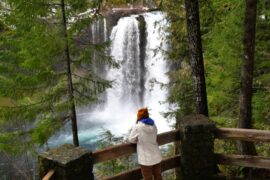
One of the best spots in this area is Koosah and Sahalie Falls, a series of two beautiful waterfalls along the icy-blue McKenzie River.
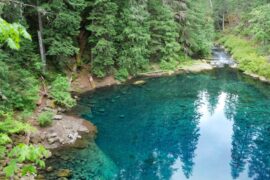
Another incredible feature of the McKenzie River is Blue Pool, a large pool where the river springs up from the ground and displays a crystal-clear blue brilliance.
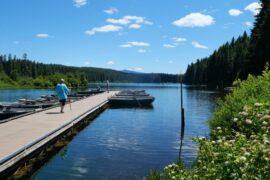
Clear Lake Oregon is also spectacular, and a worthwhile stop in summer or early fall.

Finally, you can’t miss Proxy Falls, another series of two waterfalls in a magical forest downhill from the Dee Wright Observatory.
Dee Wright Observatory FAQs
Can you go inside the observatory?
Yes! There is a small room in the observatory that has windows placed strategically for viewing nearby peaks. You can also go on the roof of the observatory for the best views!

Is there a hike?
There is a one-mile paved interpretative trail that winds through the lava rock, has interpretive signs, and provides unique perspectives of the landscape.
Are there any fees or permits?
No fees or permits are necessary. Just show up, park, and enjoy!
When is Dee Wright Observatory open?
The observatory is open as long as the McKenzie Highway is open, which is typically from mid-June to November.

Conclusion
We hope you found this article helpful in planning your visit to Dee Wright Observatory in central Oregon!
As always, be sure to leave no trace and stay on established trails.
Check out our other articles about central Oregon and other areas in Oregon.
Subscribe to our YouTube and follow us on Instagram to level up your PNW adventures. Happy roaming!